

A performance digital twin for every player.
Opti-U turns each player's telemetry into a model of how that player trains, recovers and performs. Machine learning finds the patterns, forecasts the days ahead and models injury risk and burnout, so staff can act early.
Product
Inside the dashboard.
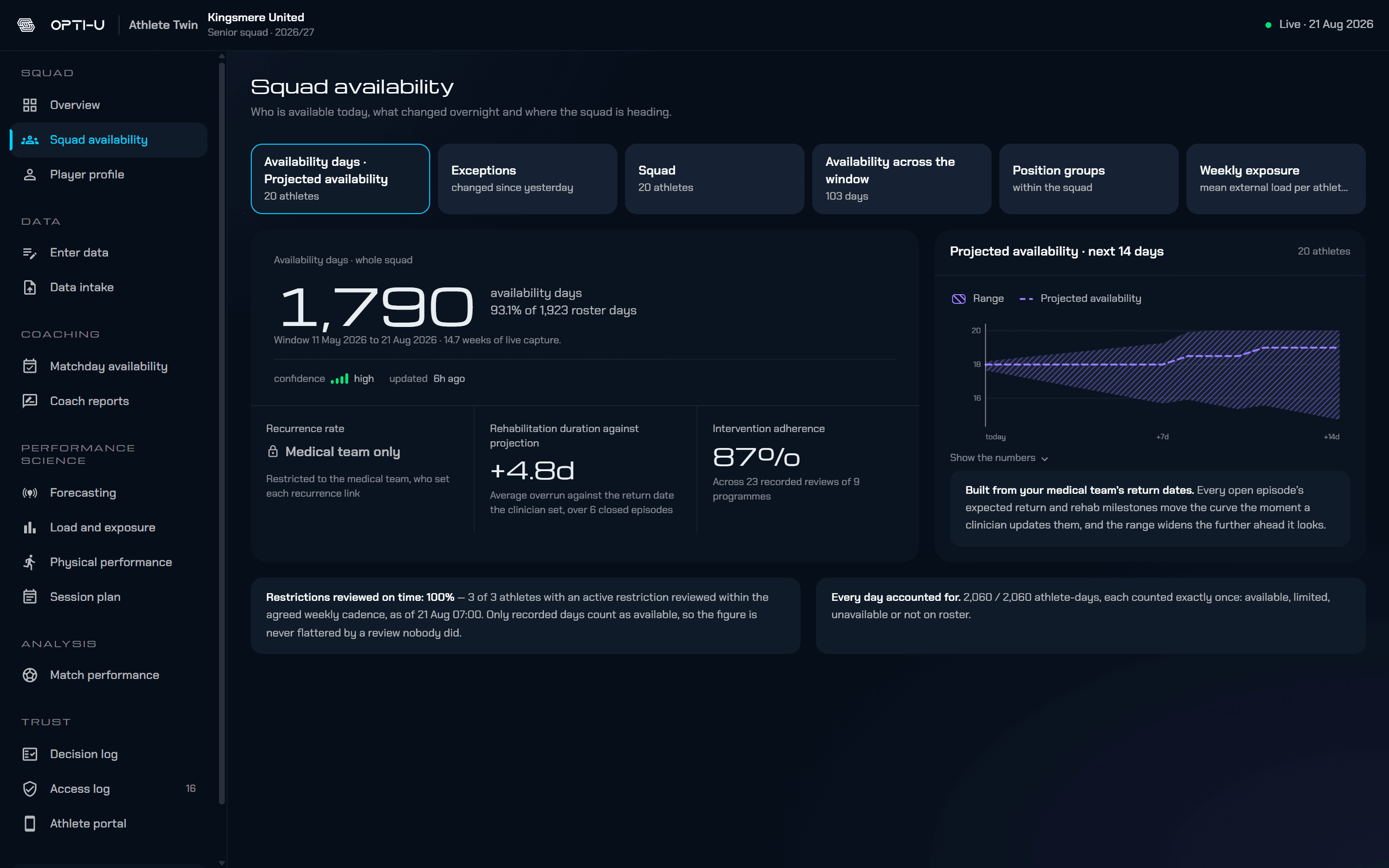
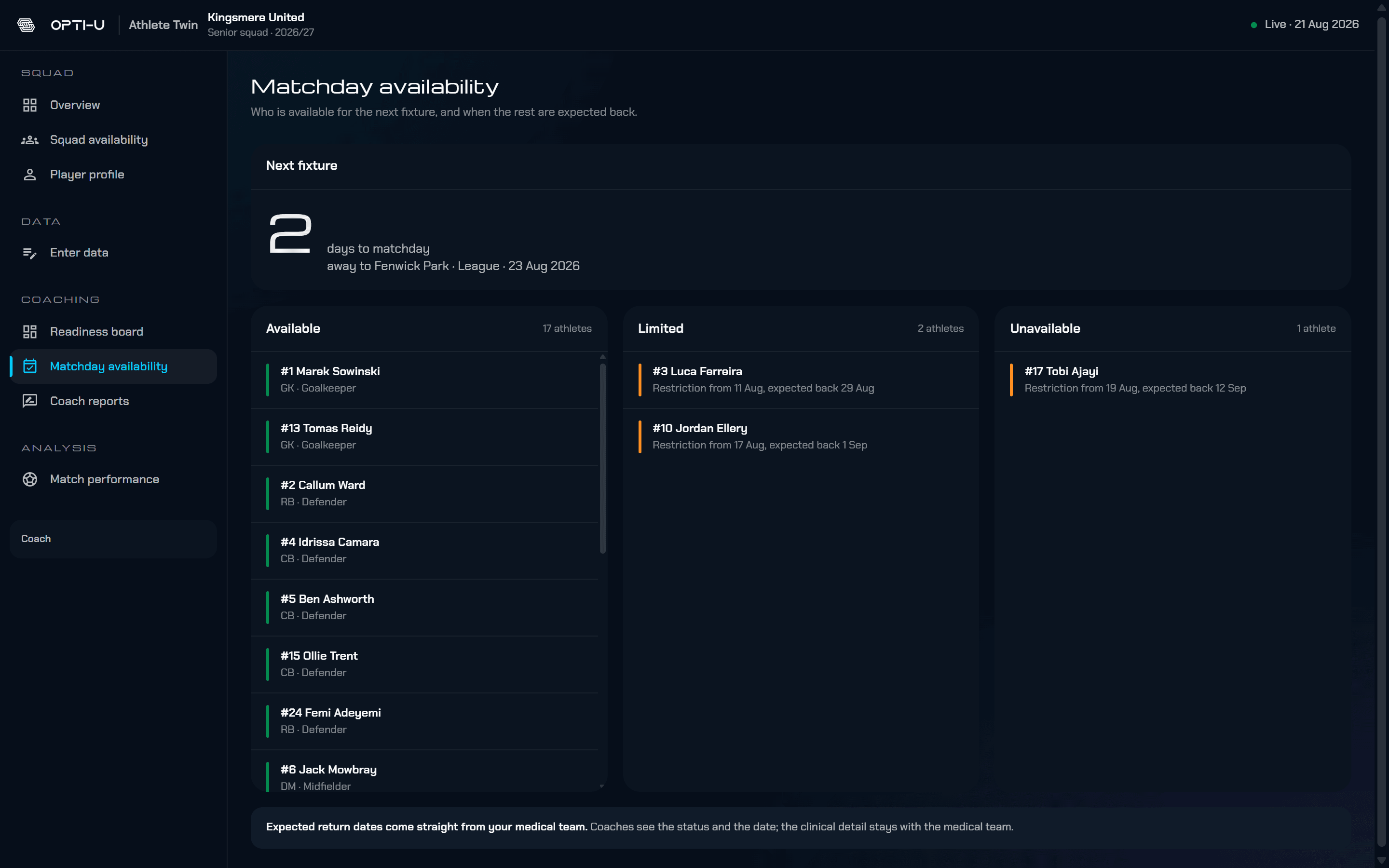
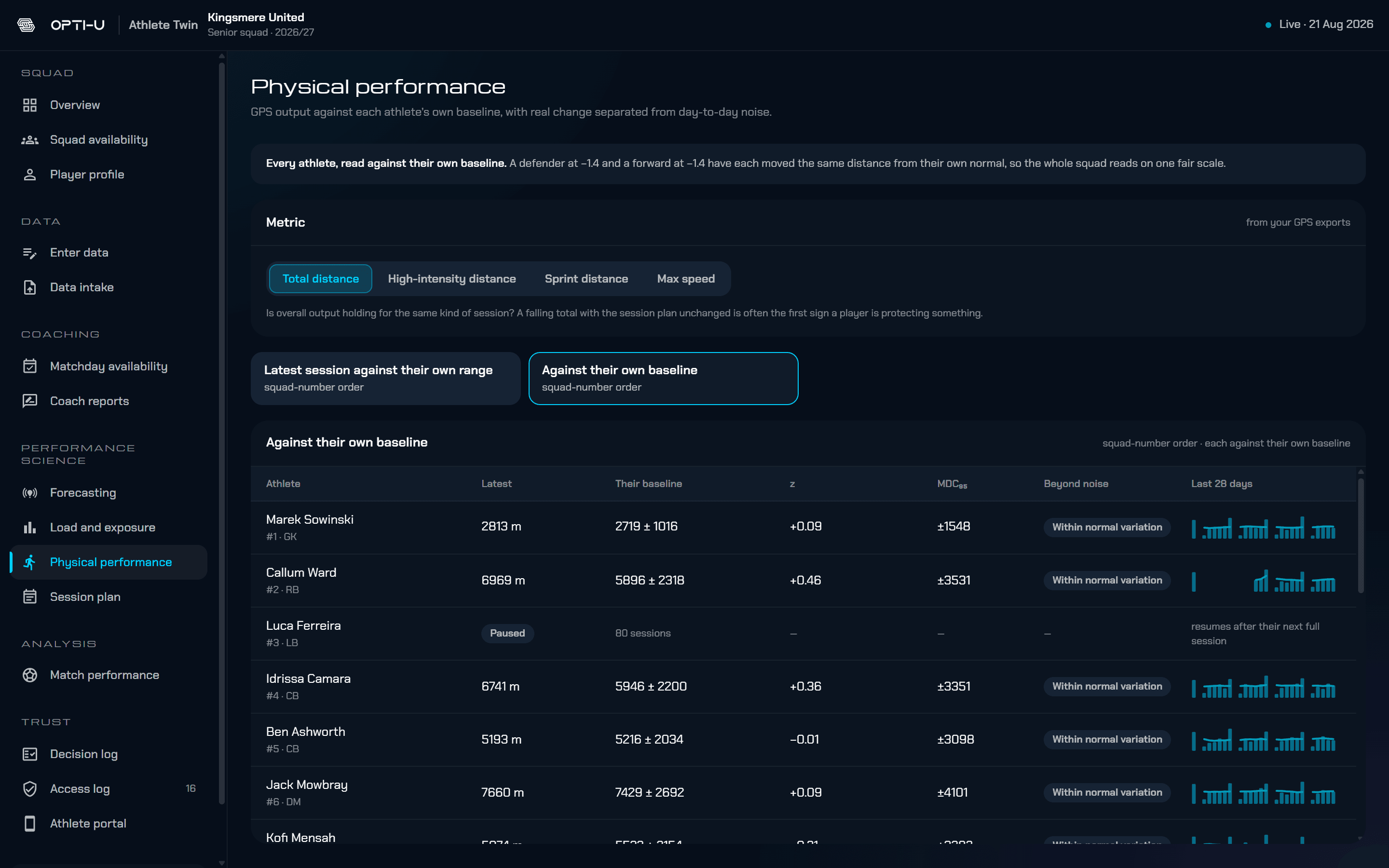
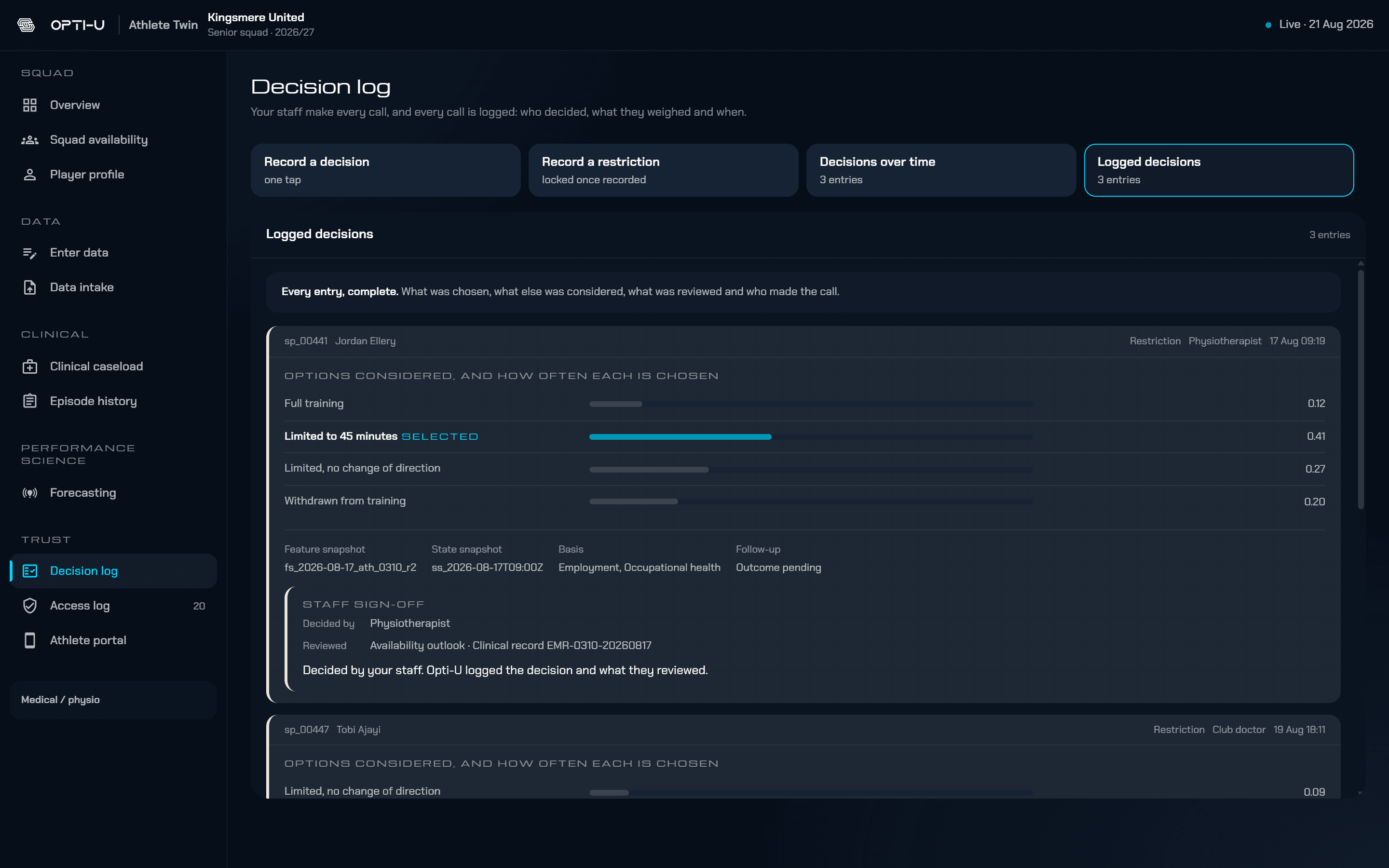
Each discipline gets its own portal, opening on availability, forecasts and the players who changed since yesterday. These screens come from our design prototype: the club, the players and every reading are fictional.
Product
Inside the dashboard.
Each discipline gets its own portal, opening on availability, forecasts and the players who changed since yesterday. These screens come from our design prototype: the club, the players and every reading are fictional.
- Squad availability
- Matchday
- Own baselines
- Decision log
About
Every player gets a digital twin.
Each twin is a model of one player, updated with every session, night's sleep and check-in. It sits above the GPS and athlete management systems a club already runs, and every value carries its confidence, data sufficiency and source.
The twin
From raw telemetry to the next call.
<01>
Data telemetry
GPS, training load, wearables, match data and daily check-ins flow into one record for each player, with the source of every reading kept.
<02>
Machine learning analysis
Models learn each player's own baselines and update as new data arrives, so every reading is judged against that player's normal.
<03>
Pattern recognition
The twin compares today with the player's whole history, finds the periods that looked alike and shows what followed them.
<04>
Forecasting
Sleep, HRV and resting heart rate are forecast 14 days ahead and recovery 7 days ahead, each with its range.
<05>
Injury risk and burnout modelling
Injury, illness, physical burnout and performance dip risk are modelled for each player over the next 14 to 21 days, against the squad's usual rate.
Forecasting
See where each player is heading.
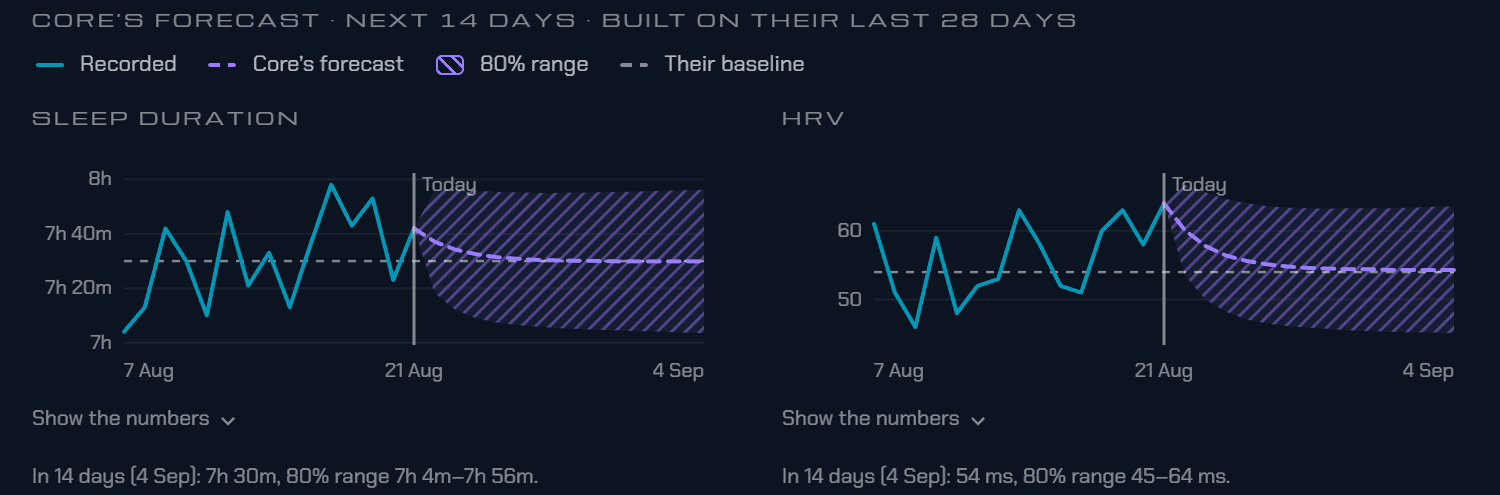
The twin projects each player's sleep, HRV and resting heart rate 14 days ahead, built on their last 28 days and set against their own baseline. Every next-day forecast is checked against the reading that follows it.
Injury risk
Injury risk for every player, every day.
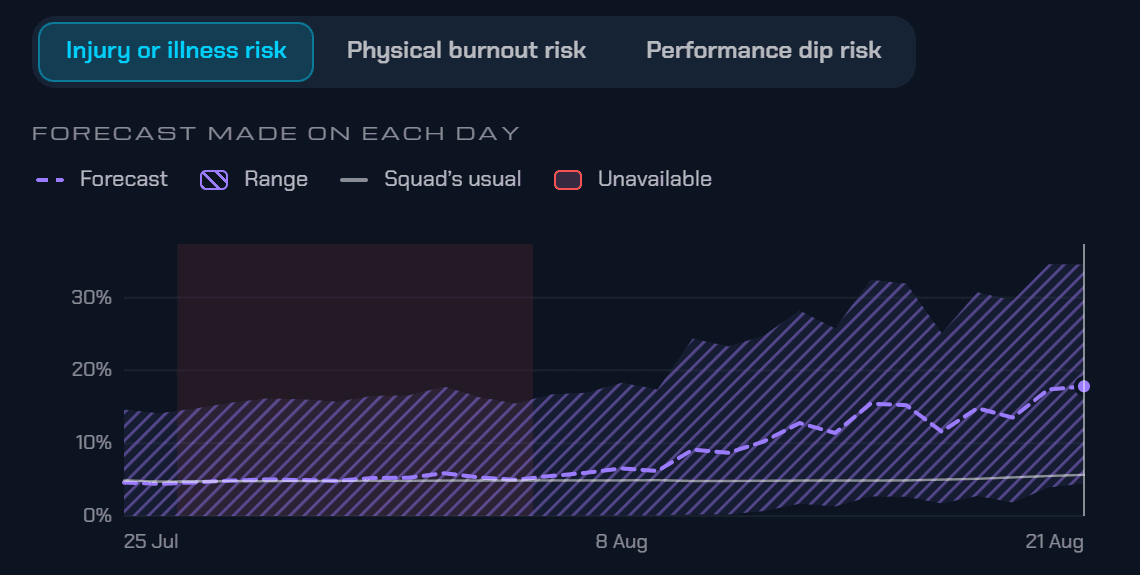
The twin produces a fresh injury and illness risk forecast for each player each day. Medical staff can watch it build, compare it with the squad's usual rate and see the signals behind it.
Burnout
Burnout and performance dips, modelled early.
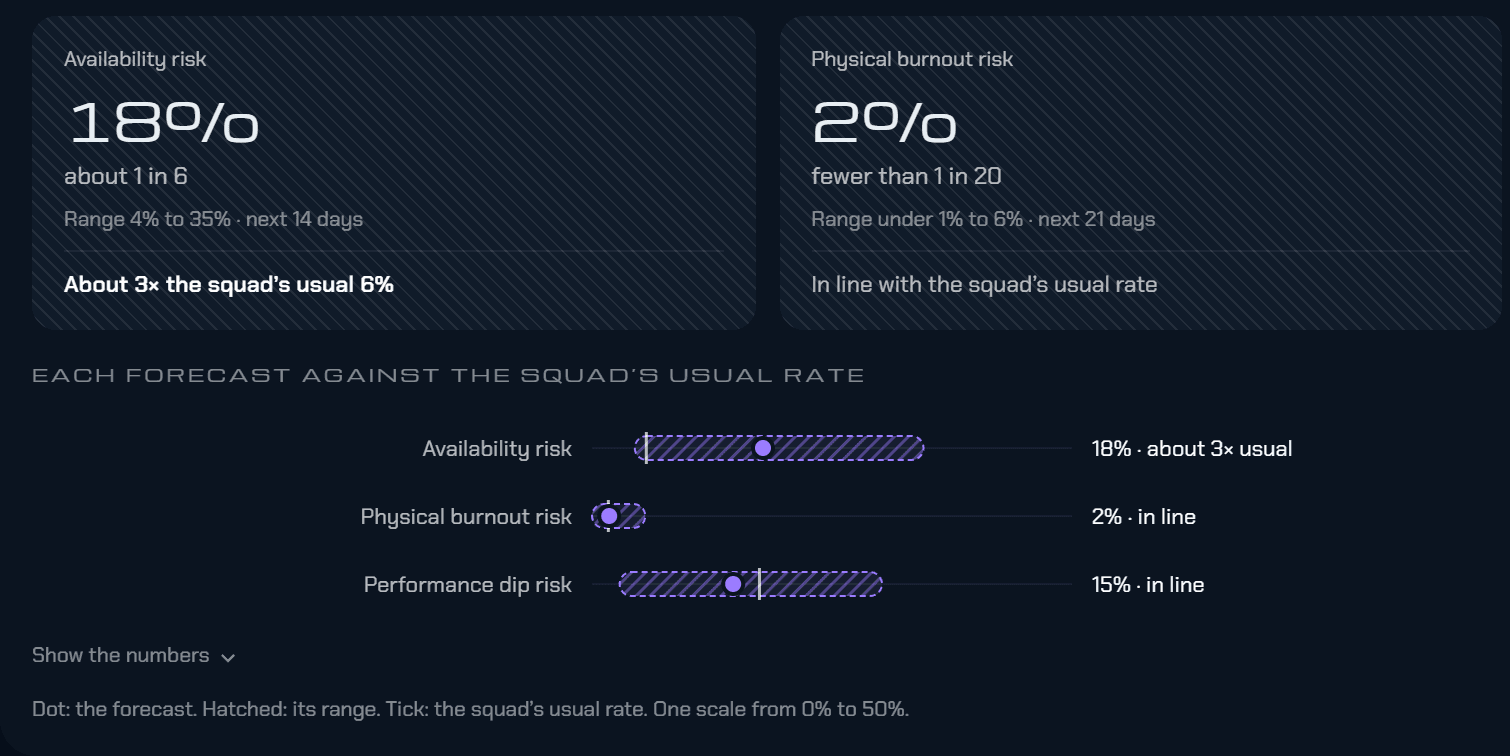
Physical burnout and performance dip risk sit beside availability risk for every player, each with its range. Staff can see which player has moved away from the squad's usual rate and adjust the week.
Pattern recognition
The twin remembers what came next.
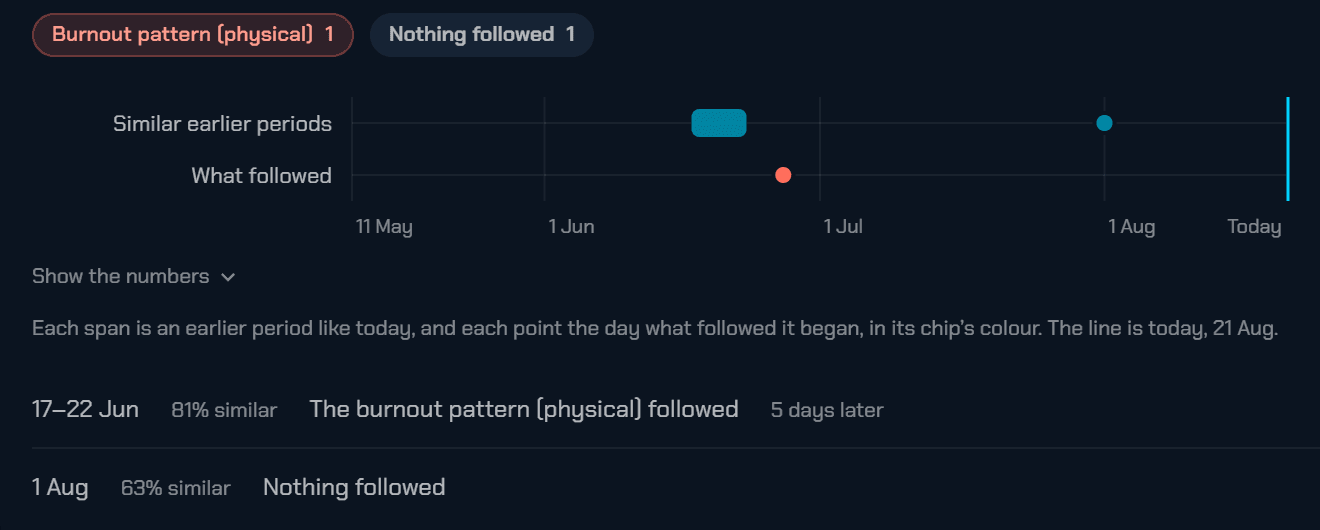
When a player starts to look like an earlier period, the twin shows that period, how similar it is and what followed. Staff see the familiar run of signals while there is still time to change the plan.
Inside the twin
See where each player is heading.
The twin projects each player's sleep, HRV and resting heart rate 14 days ahead, built on their last 28 days and set against their own baseline. Every next-day forecast is checked against the reading that follows it.
- Forecasting
- Injury risk
- Burnout
- Pattern recognition
The attention flag
An early flag on any player.
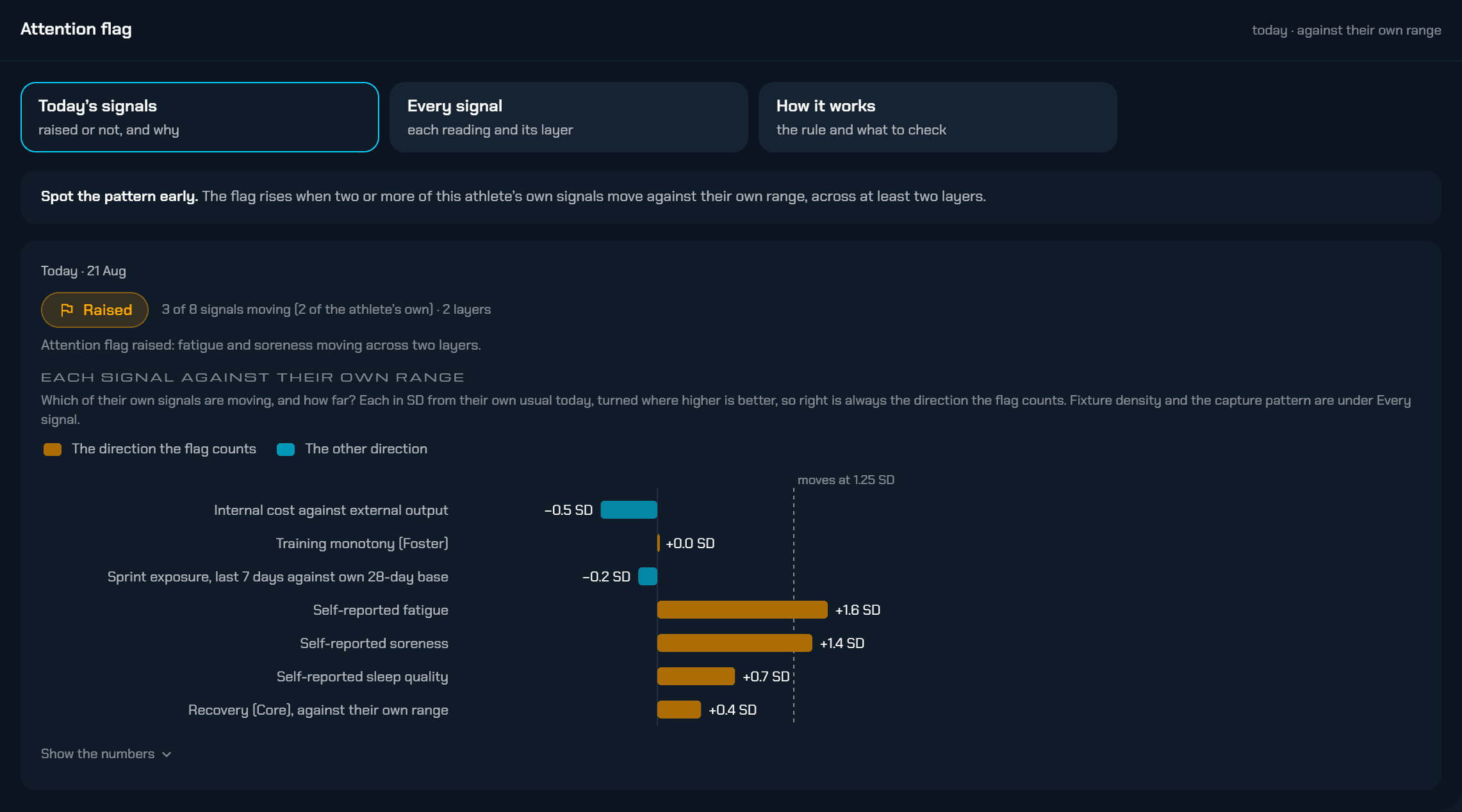
The flag rises when two or more of a player's own signals move beyond their usual range, across at least two layers such as fatigue and soreness. Staff see the signals that raised it and what to check first. On a normal day it stays down.
GPS vendors record each session.
The twin reads it against that player's own normal.
Staff spot trouble after it arrives.
The twin forecasts it each morning.
Decisions stay in people's heads.
Every call is logged with what was weighed.
The system
Athlete twin
A performance digital twin of each player that lasts across seasons, built from telemetry, availability, check-ins and practitioner decisions.
Club dashboard
A separate portal for medical, performance, sports science, coaching, analysis, nutrition, psychology and leadership. Each sees only its own access tier.
Athlete app
A daily check-in in under a minute, the player's own data, their consents and a log of who viewed their record.
Trust
Staff stay in charge of every decision.
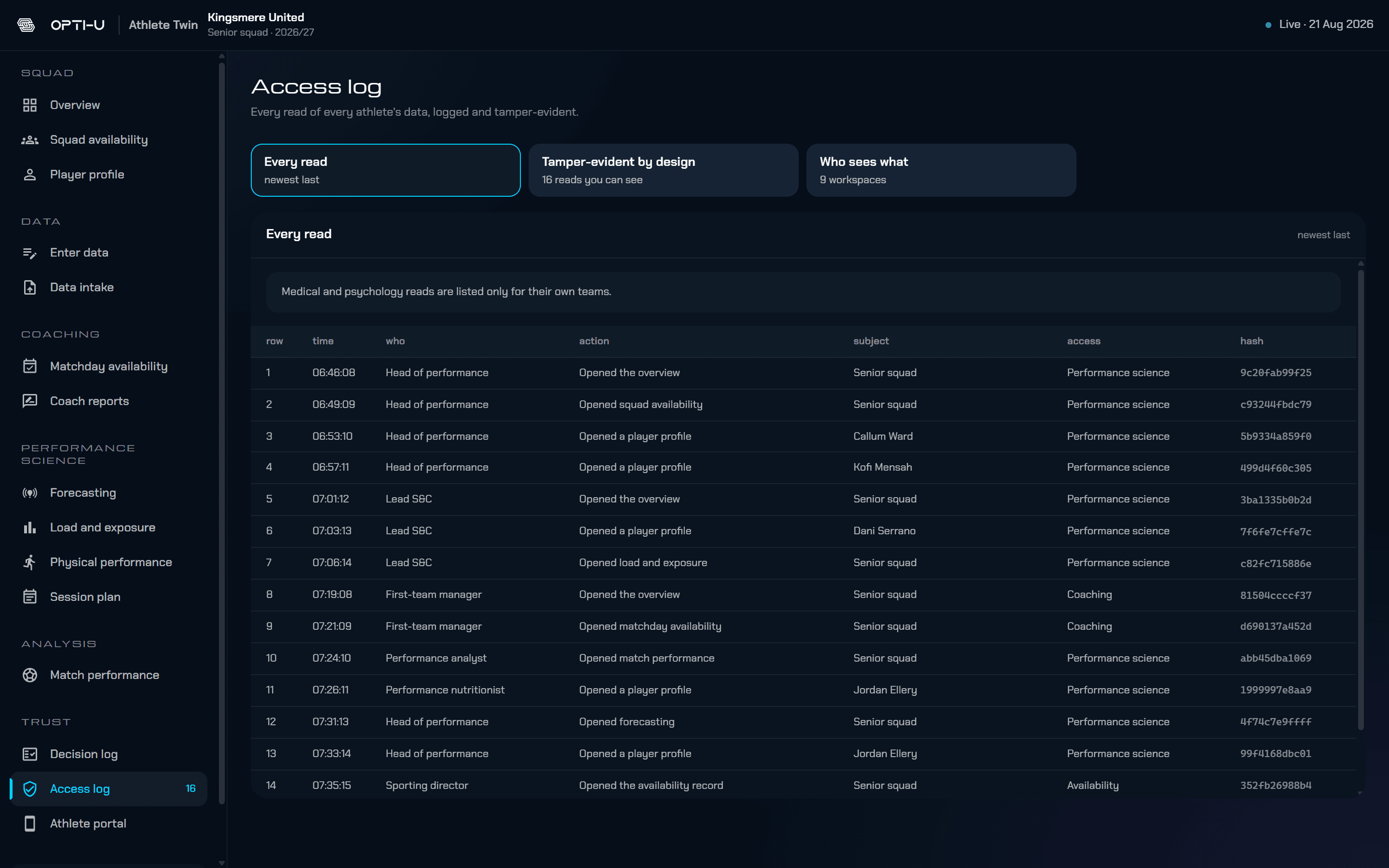
The twin gives staff the evidence. Qualified practitioners make each significant decision and the system records it. Every read of a player's record goes into a tamper-evident log, medical and psychology records sit behind separate firewalls, and player data is handled as special category data under UK and EU GDPR.
For players
Players see what is asked of them.
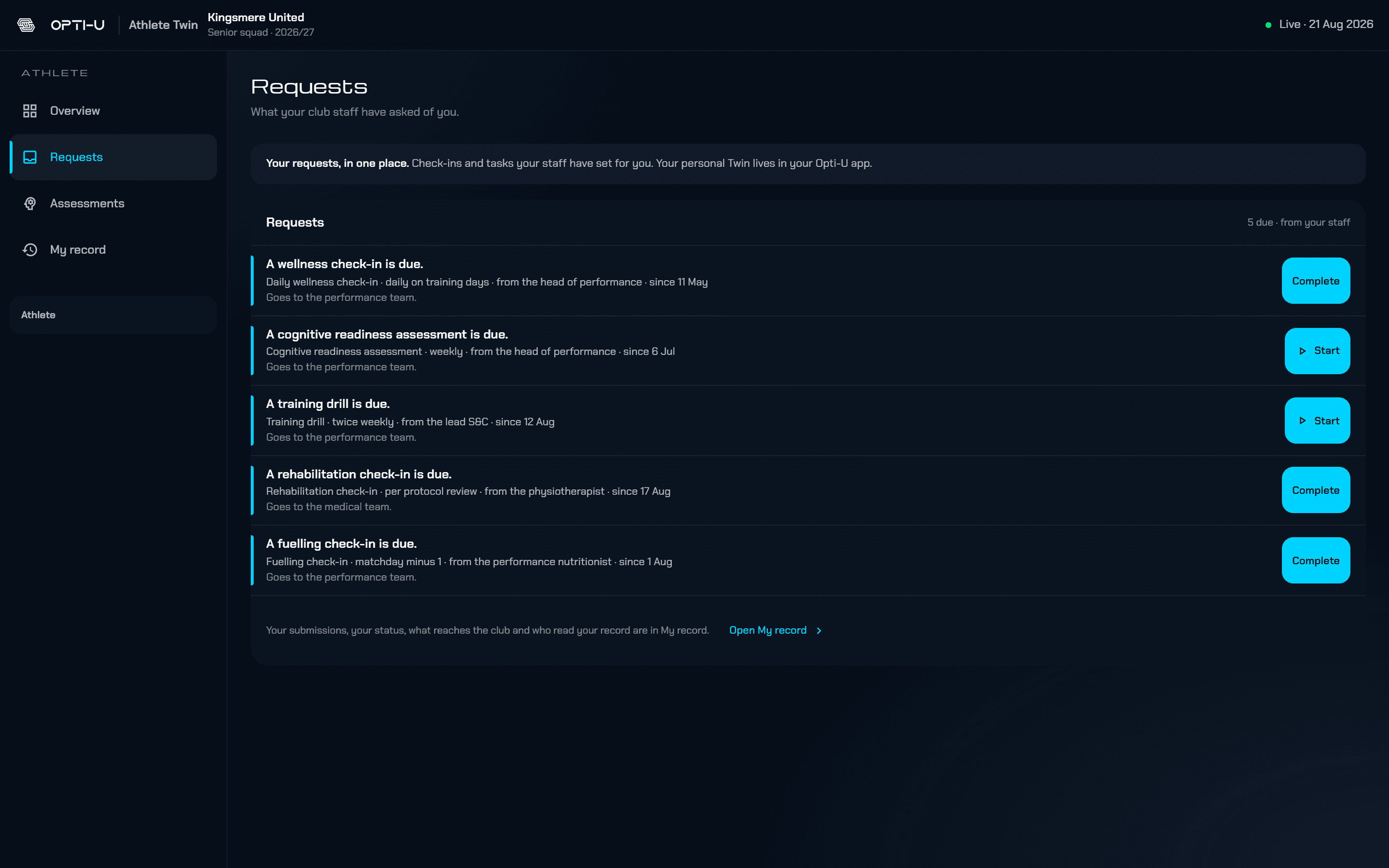
Requests from staff arrive in one place, and each says which team receives the answer. Detailed physiology from a player's own wearable stays off until they switch it on, and they can switch it off again.
Later
With the player's authorisation, their twin will be able to move with them on a transfer, so staff at the new club start from an established normal.
Contact
Opti-U is looking for design partner clubs.
Opti-U's statistical engine is built and tested on real human data. The sports layer is a working design prototype on simulated data. Design work with partner clubs starts in the 2027/28 season, and independent researchers will evaluate the first live season.